Monday, 25 July 2011

New course team symposium grants available

The Blended and Flexible Learning Course Symposiums are designed to support course teams in thinking about how they are currently using blended and flexible learning strategies in their course, and how these might be enhanced, to optimise the learning and teaching experience.

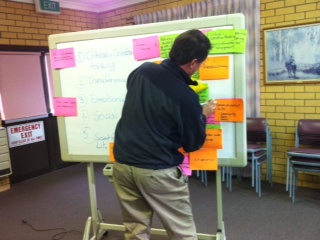
Peter Mills gets busy in the Bachelor of
Agricultural Business Management
course symposium on Friday.

Grant recipients are awarded $2000 per course to develop a BFL course strategy which indicates how blended and flexible learning will be embedded into the student experience across the course. This strategy can be used by the team in its Course Review as per the CSU Degree Initiative (blended and flexible learning), and should be developed in consideration of the principles and perspectives approach to good practice in BFL, outlined in the BFL wiki. The course team will also identify examples of BFL strategies developed during and following the symposium for sharing with the CSU community.

To apply, check out our Course Team Symposium webfolio, where you'll find details of current symposiums, as well as how to apply in 2011. Applications close on August 31, 2011.

New DVD available to support course teams in exploring BFL

Also on the agenda for tomorrow is the release of a new DVD which is designed as an introduction for course teams starting to develop their course BFL strategy. It looks at BFL from the perspectives of FLI staff and Teaching Fellows, and introduces teams to the proposed principles for good practice in BFL and the perspectives approach being suggested by FLI.

So far, the DVD has had excellent feedback from our course symposium recipients in Ontario and Orange, as indicated in this comment from Zeffie Nicholas, Ontario:

'We viewed and used the video prepared by FLI for use by Course and School teams yesterday. Sensational. It was extremely useful in providing background, contextualising our work and setting the scene for us preparing a School plan re BFL.'

Huge thanks go out to the nine inspiring FLI Teaching Fellows who were interviewed for the DVD: Yann Guisard, Jenny Sappey, Chris Bushell, Brad Edlington, Lyn Hay, Jacquie Tinkler, Lucy Webster, John Rafferty and Richard Taffe. Quite honestly, it was a pure pleasure to listen to your experiences and wisdom as we went on our 'road trip' in April. And to think that we have more FLI Fellows with just as much wisdom and experience to share to interview later this year!

A few other acknowledgments can't be missed - James Childs-Maidment did a brilliant job with filming and editing, Amy Felke was great in helping with CSU images, and the staff of LTS's media services, in particular Ian Lloyd, Ian Hamilton and Tony O'Neill blew us away with their responsiveness and professionalism in taking the master to final production.

Here's a sneak preview of the trailer:


If you are interested in obtaining a copy of the full DVD, please contact FLI. When you receive it, you'll notice a black and white image on the back of the case. If you haven't seen these before, it's a QR code, and it lets you access this blog from your mobile just by pointing it at the image. More aout QR codes and how they can be used in education next week.

Happy viewing!

A wiki to build what we know about BFL together

Tomorrow we're announcing a new wiki site - Designing for blended and flexible learning - which is designed to CSU support course teams in their investigations of BFL and how they might achieve the right 'blend' of learning opportunities within their own courses. This is a sneak preview!

The site isn't about providing step by step instructions about what you tools you should use, what spaces you should set up and so on. Instead, it provides a set of underlying principles that your course might aspire to, and asks you to integrate those which resonate with your team into any current set of principles or model that you are working from. Then, as a way towards operationalising these principles, it suggests you consider your course from 5 different perspectives - pedagogy, interactions, learning spaces, ICTs and multi-literacies - as a way of reducing the complexity of course redesign as you work towards a cohesive strategy for enhancing BFL within your course.

The development of the site is strongly influenced by the work of Lave and Wenger (1991) on situated learning, as well as that of Jane Hart, Jay Cross, Harold Jarche and Clark Quinn on informal learning in the workplace. We wanted to create a resource that people could use and interact with in their own space and time, when they needed it - a support for their own formal and informal learning. We wanted something that was dynamic, sustainable in that it is easy to maintain to keep pace with new developments and resources, and able to easily incorporate contributions from others in the CSU community. We wanted something that people could 'dip into' depending on their interests, contexts, experience and needs, not something that had to be worked through in a linear fashion from woe to go. In short, we were looking for an efficient, effective path that made it easy for people to get what they need when they need it. We hope we've gone some way towards achieving that, but time will tell. :)

You can read more about the site, and how it's been set up, in the overview. Some typical questions are also answered in our FAQs. We'd love to hear your feedback on the site: please leave a comment here or email fli@csu.edu.au directly!

Wednesday, 13 July 2011

News from EduLearn2011 - Professor Mike Keppell

EduLearn2001 was in Barcelona and brought together a great crowd and intersting papers. I had four favourites:
Martin Weller spoke about digital scholarship – his blog is worth the read.  He examined the nature of open publication at Ed-Media. Peter Shea examined an extension of the Community of Inquiry model. He elaborates the model. His presentation was excellent! Joe Luca has developed an elaborate online supervisor compliance training for academics. Although I'm not thrilled by the compliance term it is a good framework.  

Sugata Mitra gave an inspirational keynote at EDULEARN11. He is the person who developed the 'Hole-in-the-Wall'. See  particularly the interviews.

There were representatives from 70 different countries at EDULEARN11 in Barcelona which was interesting in itself in terms of the cultural exchange of ideas. Other good stuff: https://scoop.it// and http://paper.li/

News from EduLearn11 (Professor Mike Keppell)

Hi folks,
I've just been at the EduLearn2011 Conference in Barcelano. I usually look for only three new ideas at any conference, so here they are my favourites:

Martin Weller spoke about digital scholarship – it's worth visiting his blog! He examined the nature of open publication at Ed-Media. Peter Shea examined an extension of the Community of Inquiry model, which he elaborated - excellent presentation. Joe Luca has developed an elaborate online supervisor compliance training for academics. Although I'm not thrilled by the compliance term it is a good framework.  
OK, I'm going to make that four favourites!

Sugata Mitra gave an inspirational keynote at EDULEARN11. He is the person who developed the 'Hole-in-the-Wall' He is the person who developed the 'Hole-in-the-Wall' See https://weboutlook.csu.edu.au/owa/redir.aspx?C=db299a536ff34e97a2a24791293706c1&URL=http%3a%2f%2fwww.hole-in-the-wall.com%2findex.html particularly the interviews.
There were representatives from 70 different countries at EDULEARN11 in Barcelona which was interesting in itself in terms of the cultural exchange of ideas. For other good stuff:

Monday, 6 June 2011

Some foundation principles - what do you think?

Now what have we missed?
The problem with principles is that you can never get them right. What might be principles for good practice in one context may not lead to good practice in another. In fact, you can bet that they won't. And when it comes to blended and flexible learning (BFL), which is characterised by an almost infinite array of possibilities and choices for designers and teachers, the complexities are compounded. Which brings us to the question, 'What can we offer CSU course teams, as a set of foundational principles, to guide their course redesign in terms of BFL?'

Like most things complex and worthy of considerable thought, what we have offer has gone through a number of iterations. We started by talking to people - academics, teaching fellows, educational designers, managers - about what good practice in blended and flexible learning might look like. We had lively discussions about what might and might not be included, and ended up with a list of 14 design principles. So far so good...

Then along I came, and started looking at these principles from a designer perspective, as someone who would have to implement these with course teams. And I struggled. I needed to make sense of these for myself - to see where and how they related to other areas of the CSUDegree, the aspirational framework that FLI had developed, and what I already knew about blended and flexible learning from the literature and my own experiences.

And so I moulded and reworked them, while still trying to be true to the ideas of the original reference group. What we have now is a set of 10 principles, which still aren't 'right', but which we're satisfied with for now. And I think that's OK because of the way we are offering them. Firstly, they aren't offered as a 'prescription' or recipe that CSU course teams have to follow. We're offering them as a starting point, from which each course team might think about why they are moving more towards BFL, what foundational principles might inform that move, and how these relate to any other set of course principles they may have. In that way, we're hoping you will mould them to suit your context, just as I did. 

Secondly, we aren't offering them as a definitive list. We'd like you to comment (on this post) on the usefulness of these principles for your BFL design, and how we might continue to redefine what good practice in blended and flexible learning means at CSU.

So here they are...
Let's start with two vital principles, which form part of the BFL Standards ratified by Academic Senate: that good practice in blended and flexible learning is student-centred and equivalent between cohorts. These principles also reflect CSU's core values.

Student centred - Effective BFL design provides engaging, motivating and intellectually stimulating learning experiences focussed on the individual and social needs of the learners, rather than those of teachers or administrators. Active participation in learning activities should be fostered through emphasising the interactive and social dimensions of learning both in physical and virtual environments. Students also need opportunities to become independent learners and to take responsibility for their own learning.

Equivalent - Effective BFL design encompasses the ethical obligation to support, respect and provide equitable learning and assessment experiences for all of our diverse range of students. Equivalence should exist between and across different cohorts, ensuring that resources and facilitation processes normally only provided to one cohort are available to all, and that there are equivalent support mechanisms to cater for accessibilty and convenience.

In addition to these core principles, CSU has identified 8 other supporting principles which are important to ensuring consistently high quality learning experiences and outcomes for all CSU undergraduates, and in enabling academic staff to achieve this goal.

Effective practice - Irrespective of the technology used, effective BFL design should be based on good curriculum design informed by core principles of learning, in particular alignment between course and subject aims, activities and assessments. These principles need to be thoughtfully applied, using ICTs where appropriate to enhance specific aspects of the learning process.  

Authentic - Effective BFL design maximises the synergies between theory, professional practice and community activities, and engages students in developing solutions to real world problems and issues. It recognises, values and harnesses learning that takes place both within and outside of formal learning activities.

Collaborative - Effective BFL design enhances opportunities for learners to work together cooperatively to achieve learning outcomes. This may involve both face-to-face and online opportunities, and may bring together on-campus and off-campus students where possible and appropriate.

Lifelong - Effective BFL design enhances learners' ability to continue their learning independently after graduation. This may involve building a personal learning network and developing their skills in a range of literacies.

Appropriate - Effective BFL design is based on thoughtful choices in pedagogies, learning spaces, interactions, ICTs and literacies according to their affordances, blending them in a way that is contextually appropriate to meet the required learning outcomes.

Innovative - Effective BFL design fosters transformative change and innovative and creative approaches to student learning which are informed by current research.

Sustainable - Effective BFL design requires an approach that can be maintained over time and which accommodates the nuanced shifts fundamental to rapid technological change. Ideally, learning designs and objects should be reusable - used again by others in similar contexts with slight modifications.

Continuous improvement - Effective BFL design fosters a dynamic environment of continous improvement, simultaneously leading and responding to developments in university teaching and learning at all levels. Ongoing renewal is important to BFL to ensure that courses, subjects, activities and assessments remain future orientated. For CSU teaching staff, continuous improvement also involves regularly enhancing teaching practice through professional development and reflection. 

So, do these work for your course team? How would you change them?  

Posted by Carole