Tuesday, 30 August 2011

What questions do you want to ask your peers about blended and flexible learning?

Who Knows What You'll Find When You Ask Questions
How often do you get asked to complete a survey, have the results returned to you, but really, they haven't asked the kinds of questions you'd want to ask? For me, that happens quite a bit.

So I was a pretty happy gal when, thanks to the ever-wonderful Tom Kuhlman's Rapid eLearning blog, I came across Urtak this morning. It touts itself as 'a tool for collecting opinions', and is made of up 'yes/no' questions, with a 'don't care' option as well. The creator sets up to 10 questions which are asked in random order. This means you can't choose which questions to answer, and this urked me at first - I wanted to skip over some questions and see what all others were. But I soon caught on that if I wasn't interested in a question, I just responded 'don't care'. The more 'don't care' responses there are to a question, the less likely it is that it will be asked again - so the better questions get asked more often.

But the bit I like is that the participants are able to ask their own questions. It immediately engaged me - what do I want to find out from my peers? Are the issues that are critical to me the same as they are for you? Are the assumptions we're making about what are the critical issues to our staff really warranted? And what questions are others asking?

As soon as you answer a question, you get to see a pie chart of how others have responded. And asking is as quick as type and click, once you've signed up (email address and password), which I admit is a bit of a draw back, even though it only took a second or two.

I tried it out with a few simple questions, but I'm more interested in the kinds of questions you are asking about blended and flexible learning at CSU. Have a go, and add some questions of your own!

Blended and flexible learning

The value for blended and flexible learning?
As Tom says in his post, the value is in its simplicity and the potential in using the questions to engage people. He suggests asking questions that elicit strong opinions and prompt some thought, then following this up by offering on- or offline facilitated discussion where students can qualify and strengthen these opinions after more in-depth discussion (something that's not possible, of course, with a yes/no response). In essence, this is using it to engage students and prime them for further conversation. He offers a good example, which you'll see when you read his post.

I'd like to suggest another use for this tool though. When designing to assist students in transitioning into the university environment, it's important to consider the development of community, and the sense of belonging that comes from knowing what the cohort that one is studying with is all about. With our distance students, this has traditionally been much harder, though new technologies such as our ePortfolio system and online meeting tools, supplementing the discussion forums, have added to that greatly. I'd really like to see, though, how a tool like this might work at the start of first semester. What kinds of questions do students want to know about each other? How can it be used, in conjunction with forums and orientation camps etc, to help students gain a stronger sense of who they are as a group?

I also imagine using this as a tool during work placements, asking some of those controversial questions that they will undoubtedly be drawing opinions on as they see how their profession works in the real world, looking at the kinds of questions they are posing themselves, and using these as prompts for follow-up discussions.

Lots of food for thought. If anyone tries it out with their classes, I'd love to hear how it went! Here's a link to Tom's quick overview tour

Photo: cc licensed ( BY ) flickr photo by [F]oxymoron: http://flickr.com/photos/f-oxymoron/5005146417/

Monday, 1 August 2011

BFL initiatives launched in Bathurst

Director of the FLI, Professor Mike Keppell and Deputy Director, A/Prof Merilyn Childs, at the launch of the "Practitioner's Voice" DVD


Last Wednesday, FLI launched a range of initiatives to support course teams in developing a course-based BFL strategy. We've since announced most of those initiatives independently here on this blog: the BFL wiki, course team symposiums, the 'Exploring Good Practice' DVD, our Delicious bookmarking site and of course, this blog itself.

It was great to see so many people at the launch - Prof Ross Chambers, our DVC, and A/Prof Ken Dillon, our new Dean of Studies were there, along with Katherine Klapdor, Director of Educational Design and Media, former and current teaching fellows, and a range of staff from across the university, particularly Learning and Teaching Services.

We have recorded the launch, and hope to have this available soon to those who were unable to make it. If you're interested in viewing a trailer of the DVD, check it out here:


Otherwise, please contact FLI for your copy.

So where to now?

Well, there's quite a bit happening over the next few months:

  • On August 18, we'll be facilitating a CSUDegree bookclub event around BFL - for more information, check What's New. 
  • Following on from the bookclub, we'll be holding a series of special 59mins@FLI online meetings around each of the 5 perspective areas. 
  • Three more symposiums are being offered - deadline 31 August, 2011.
  • We'll be distributing the Good Practice DVD more widely, especially to L&T committees. If you'd like to get in early, contact fli@csu.edu.au
  • We'll be holding two workshops and some presentations at CSUEd in November - one on developing your own DIY course symposium, and another on the aspirational framework. 
  • We'll be building on the material already included in the BFL wiki, including more case studies.

Thanks to the many people who made the DVD happen: of course, to James Childs-Maidement, our fantastic Media Officer who did all the filming and editing; to Amy Felke for her assistance in locating CSU images; to the LTS production staff, especially Ian Lloyd, Ian Hamilton and Tony O'Neill; to LTS' educational design team for ongoing feedback; and especially to our FLI Teaching Fellows - Yann Guisard, Jenny Sappey, Chris Bushell, Brad Edlington, Lyn Hay, Jacquie Tinkler, Lucy Webster, John Rafferty, Richard Taffe - for so graciously sharing their insights and experiences in relation to blended and flexible learning.

Let the mad rumpus begin!

Monday, 25 July 2011

New course team symposium grants available

The Blended and Flexible Learning Course Symposiums are designed to support course teams in thinking about how they are currently using blended and flexible learning strategies in their course, and how these might be enhanced, to optimise the learning and teaching experience.

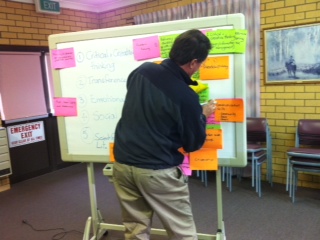
Peter Mills gets busy in the Bachelor of
Agricultural Business Management
course symposium on Friday.

Grant recipients are awarded $2000 per course to develop a BFL course strategy which indicates how blended and flexible learning will be embedded into the student experience across the course. This strategy can be used by the team in its Course Review as per the CSU Degree Initiative (blended and flexible learning), and should be developed in consideration of the principles and perspectives approach to good practice in BFL, outlined in the BFL wiki. The course team will also identify examples of BFL strategies developed during and following the symposium for sharing with the CSU community.

To apply, check out our Course Team Symposium webfolio, where you'll find details of current symposiums, as well as how to apply in 2011. Applications close on August 31, 2011.

New DVD available to support course teams in exploring BFL

Also on the agenda for tomorrow is the release of a new DVD which is designed as an introduction for course teams starting to develop their course BFL strategy. It looks at BFL from the perspectives of FLI staff and Teaching Fellows, and introduces teams to the proposed principles for good practice in BFL and the perspectives approach being suggested by FLI.

So far, the DVD has had excellent feedback from our course symposium recipients in Ontario and Orange, as indicated in this comment from Zeffie Nicholas, Ontario:

'We viewed and used the video prepared by FLI for use by Course and School teams yesterday. Sensational. It was extremely useful in providing background, contextualising our work and setting the scene for us preparing a School plan re BFL.'

Huge thanks go out to the nine inspiring FLI Teaching Fellows who were interviewed for the DVD: Yann Guisard, Jenny Sappey, Chris Bushell, Brad Edlington, Lyn Hay, Jacquie Tinkler, Lucy Webster, John Rafferty and Richard Taffe. Quite honestly, it was a pure pleasure to listen to your experiences and wisdom as we went on our 'road trip' in April. And to think that we have more FLI Fellows with just as much wisdom and experience to share to interview later this year!

A few other acknowledgments can't be missed - James Childs-Maidment did a brilliant job with filming and editing, Amy Felke was great in helping with CSU images, and the staff of LTS's media services, in particular Ian Lloyd, Ian Hamilton and Tony O'Neill blew us away with their responsiveness and professionalism in taking the master to final production.

Here's a sneak preview of the trailer:


If you are interested in obtaining a copy of the full DVD, please contact FLI. When you receive it, you'll notice a black and white image on the back of the case. If you haven't seen these before, it's a QR code, and it lets you access this blog from your mobile just by pointing it at the image. More aout QR codes and how they can be used in education next week.

Happy viewing!

A wiki to build what we know about BFL together

Tomorrow we're announcing a new wiki site - Designing for blended and flexible learning - which is designed to CSU support course teams in their investigations of BFL and how they might achieve the right 'blend' of learning opportunities within their own courses. This is a sneak preview!

The site isn't about providing step by step instructions about what you tools you should use, what spaces you should set up and so on. Instead, it provides a set of underlying principles that your course might aspire to, and asks you to integrate those which resonate with your team into any current set of principles or model that you are working from. Then, as a way towards operationalising these principles, it suggests you consider your course from 5 different perspectives - pedagogy, interactions, learning spaces, ICTs and multi-literacies - as a way of reducing the complexity of course redesign as you work towards a cohesive strategy for enhancing BFL within your course.

The development of the site is strongly influenced by the work of Lave and Wenger (1991) on situated learning, as well as that of Jane Hart, Jay Cross, Harold Jarche and Clark Quinn on informal learning in the workplace. We wanted to create a resource that people could use and interact with in their own space and time, when they needed it - a support for their own formal and informal learning. We wanted something that was dynamic, sustainable in that it is easy to maintain to keep pace with new developments and resources, and able to easily incorporate contributions from others in the CSU community. We wanted something that people could 'dip into' depending on their interests, contexts, experience and needs, not something that had to be worked through in a linear fashion from woe to go. In short, we were looking for an efficient, effective path that made it easy for people to get what they need when they need it. We hope we've gone some way towards achieving that, but time will tell. :)

You can read more about the site, and how it's been set up, in the overview. Some typical questions are also answered in our FAQs. We'd love to hear your feedback on the site: please leave a comment here or email fli@csu.edu.au directly!

Wednesday, 13 July 2011

News from EduLearn2011 - Professor Mike Keppell

EduLearn2001 was in Barcelona and brought together a great crowd and intersting papers. I had four favourites:
Martin Weller spoke about digital scholarship – his blog is worth the read.  He examined the nature of open publication at Ed-Media. Peter Shea examined an extension of the Community of Inquiry model. He elaborates the model. His presentation was excellent! Joe Luca has developed an elaborate online supervisor compliance training for academics. Although I'm not thrilled by the compliance term it is a good framework.  

Sugata Mitra gave an inspirational keynote at EDULEARN11. He is the person who developed the 'Hole-in-the-Wall'. See  particularly the interviews.

There were representatives from 70 different countries at EDULEARN11 in Barcelona which was interesting in itself in terms of the cultural exchange of ideas. Other good stuff: https://scoop.it// and http://paper.li/